
about what I stand for
I work on societal challenges, first and foremost. That means I do what the challenge calls for, not necessarily what a client wants or what I personally prefer. Those three do not always align. Innovation, after all, often requires breaking with routines, which can make it contentious. Critically examining one another’s reflexes is therefore part of every change, and is also embedded in the code of conduct for consultants.
I try to direct that critical eye mainly toward how we attempt to get things done. My field is less about content than about processes of this kind: changing, learning, organizing, advising, and researching. In them, I have gathered know-how: a broad knowledge base about what works and what does not (‘know’) and the craftsmanship to bring that to life (‘how’). I use that know-how to guide others, especially where hard-won lessons are being ignored, with the predictable consequences that brings.
Across my publications, a number of principles recur. They are both valuable and often well established in the scientific literature, yet they remain anything but common practice. That is partly because mastering them takes effort, and partly because deviating from what people expect tends to generate pushback. I therefore underline these principles whenever it seems opportune. Let me name a few:
- Multiplicity. Complex issues are multifaceted, so multiple perspectives are needed to understand them. There is not one approach to address them either; a varied repertoire is needed as well. Multiple voices catalyze this kind of plural thinking and action.
- Inquiry-driven work. You only come to understand complex issues by working on them. That means you do not first devise a solution and then implement it. Your approach cannot be linear or project-driven; it develops incrementally as your understanding grows.
Stacking small-scale changes. Deep innovation emerges in local practices. To achieve scale, such innovations need to be accumulated and connected. It does not work well when a few people have to orchestrate all of that. It works much better when many people concurrently do connecting work alongside their local practice: a patchwork perspective. - Discovering patterns. People are powerless when they cannot see how the systems they are part of condition their behavior. Only once we discern those patterns can we begin to influence them ourselves. There are many kinds of patterns, such as behavioral habits, institutional routines, and cultural norms. The more you uncover, the freer you become.
- Disrupting dominance. Many patterns are not random. They have developed historically and are reinforced by power relations and prevailing beliefs. That interplay sustains the status quo, even when it has destructive consequences for societal challenges. It is therefore an inseparable part of our work to destabilize such forms of dominance and, in the space that opens up, demonstrate innovations.
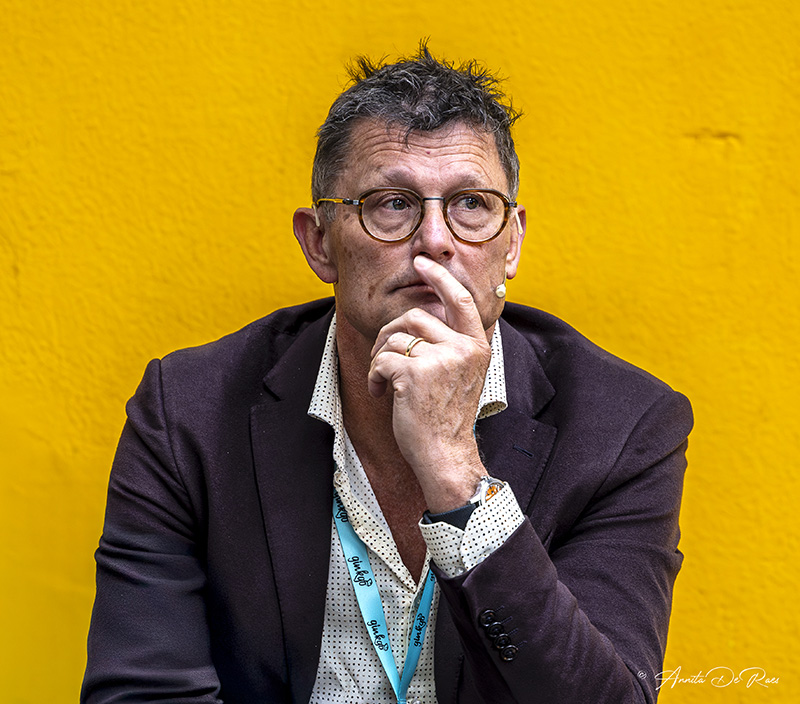
My publications reflect what I have developed professionally and what I stand for. See my publication list, or explore the English language publications.
about what I do
I support change efforts, especially around societal challenges such as climate, education, and health care. My work is rarely limited to organizational change itself: we address internal changes only when they are needed to create greater impact externally.
Read more
about how I work
The issues I work on are rarely controllable or predictable. That means the approach cannot be known in advance, much less rolled out as a project. In such cases, I treat change as an ongoing process of understanding more deeply, designing more intelligently, and acting more powerfully.
Read more
about who I work with
I work independently, but not alone. I always work with others. The most intensive collaboration happens when we are trying to effect change or create knowledge. I then spend a stretch of time alongside those involved, especially those who act as change agents and connecting weavers.
Read more
about my experience
Societal challenges are multifactorial: social, economic, political, cultural, and psychological. As a change professional, developing both an understanding and a feel for them requires a lifetime of learning without ever being done. That is what I have enjoyed doing, and still do.
Read more