Introducing a Dutch book to English speakers
NotebookLM based on Hans Vermaak, 2026
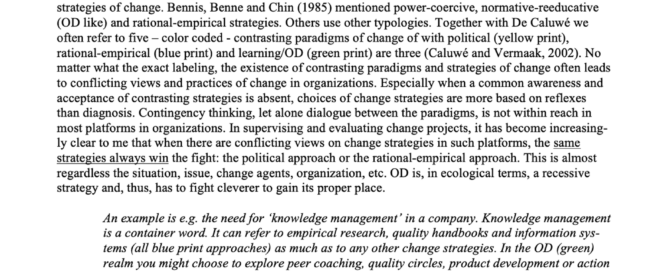
In 2025, I published a Dutch book on dealing with big hairy issues that plague our societies. Its title ‘De logica van de lappendeken’ can probably be best translated as ‘The patchwork perspective”. I am happy to say it was well received and was awarded ‘best book of the year’ in the field of management and change.
I have since received requests for an English translation of the book. Though that is not yet the case, there will be an introductory text soon (as a chapter in the book ‘Changing for the future’ coming out this fall).
In the meantime, I share two podcasts created by NotebookLM based on the Dutch source material Read more…
In: R. Shani & D. Noumair. Research in Organizational Change and Development (vol. 26) - Emerald, 2018
Hans Vermaak, Léon de Caluwé
Situating and describing the theory and its practical applications
This is the most up to date, complete and concise publication on the colors of change. It is written for both practitioners and academics that want to go beyond the basics. Those who already know about this change theory are likely to be surprised to find there is more to both the model and its applications Read more…
Hans Vermaak – Journal of Applied Behavioral Science, 2012
Why do facilitators fail when they try too hard to help people?
The complexity of tough issues can only be handled effectively with intensive local participation. Such participation is not straightforward as people may shy away from the unfamiliar repertoires, unpredictable processes and inevitable opposition that come with the territory. This paper focuses on how to facilitate local ownership in a series of paradoxical interventions with sufficient depth and credibility. Read more…
The art of making international trade more sustainable
Joost Oorthuizen, Hans Vermaak, Carla Romeu Dalmau, Elea Papemmanuel - Wageningen Academic Publishers, 2018
International trade can make a huge difference towards sustainability, as over half of what is produced globally crosses national borders. Several of the United Nations 2030 Sustainable Development Goals – such as realizing ‘zero hunger’ and ‘no poverty’, ensuring all have ‘decent work’, and taking ‘climate action’ – crucially depend on transforming the way international trade is organized. But international value chains are complicated, involving many different people working in diverse contexts that change over time. Therefore Read more…
Emerging Fundamentals
ScaleUp Practititioners, Groene Brein & Investnl, 2024
Few people disagree that circular ventures are a good thing. But how you make them a success is a different story. Three Dutch platforms joined forces to explore what enables a circular economy. As part of that research they invited an eclectic group of experts from different fields to share their thoughts and experiences Read more…
Crossing boundaries for productive interplay
Gertjan Schuiling, Hans Vermaak - International Journal of Action Research, 2017
This paper explores how action research takes place within and between four contexts: adding practical value, improving institutions, developing professions, and contributing to theory. We argue that action research is more than those activities conducted within these contexts: it is a process of handling the generative tensions in the boundary regions. Read more…
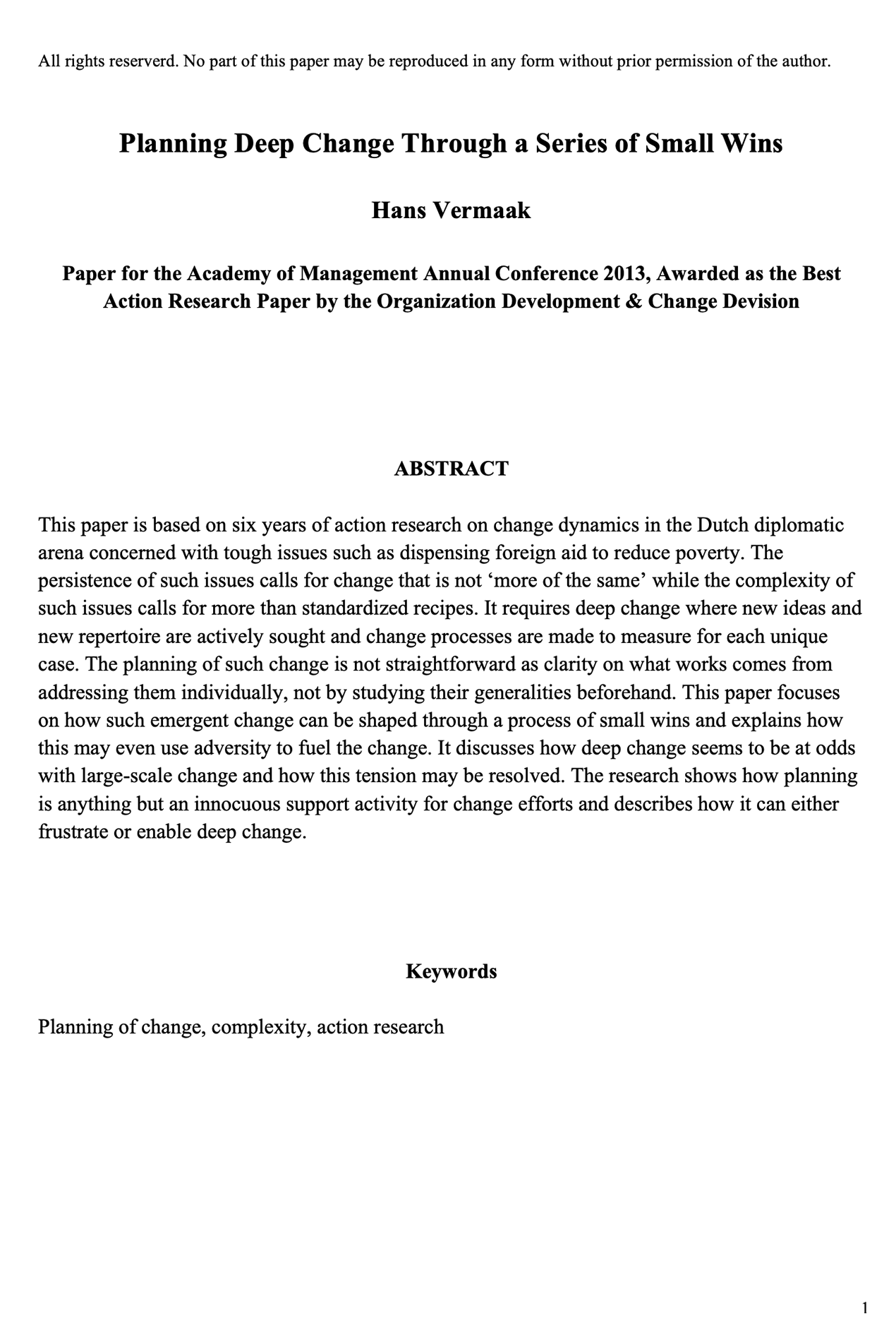
Hans Vermaak - Best Paper Academy of Management, 2013
Find out why large scale change is rarely deep and why linear change paralyzes.
Complex issues require continuous change that is planned incrementally. This paper focuses on how such emergent change can be shaped through a process of small wins and explains how this may even use adversity to fuel the change. The research shows how planning is anything but an innocuous support activity for change efforts and describes how it can either frustrate or enable deep change. Read more…
In: K. Kuitenbrouwer, T. Goudswaard, A. Schamineé. SocialDesignForWickedProblems - HNI, 2014
Hans Vermaak
Cooperation between the worlds of design, visual arts and change management
Since a few years visual artists and designers in the Netherlands have banded together with organizations to adress social issues in a different way. They focus on complex issues where sensemaking and participation is key. During the last half year or so three more action research projects were taken on with lost of enthusiasm. The movement reported on this October at the Dutch Design Week. Read more…
Textual Agency for Cross-Level Change
Danielle Zandee, Hans Vermaak & Irene Jonkers - Paper Organizational Discourse Conference, 2014
Current reforms in for instance health care or community development in troubled neighborhoods, are brave attempts at social innovations toward a more sustainable society. Such innovations ask for the questioning, discarding and renewal of ingrained practices and their re-assemblage into novel forms of collective, coordinated action. Societal, macro – level transitions play out in organizational change efforts that are especially challenging because they need to address “wicked problems” that are complex and ambiguous in terms of both content and process and therefore defy the application of simple, short – term solutions. Instead, they require a multidimensional approach and the involvement of many actors with different interests, viewpoints and affiliations. Read more…
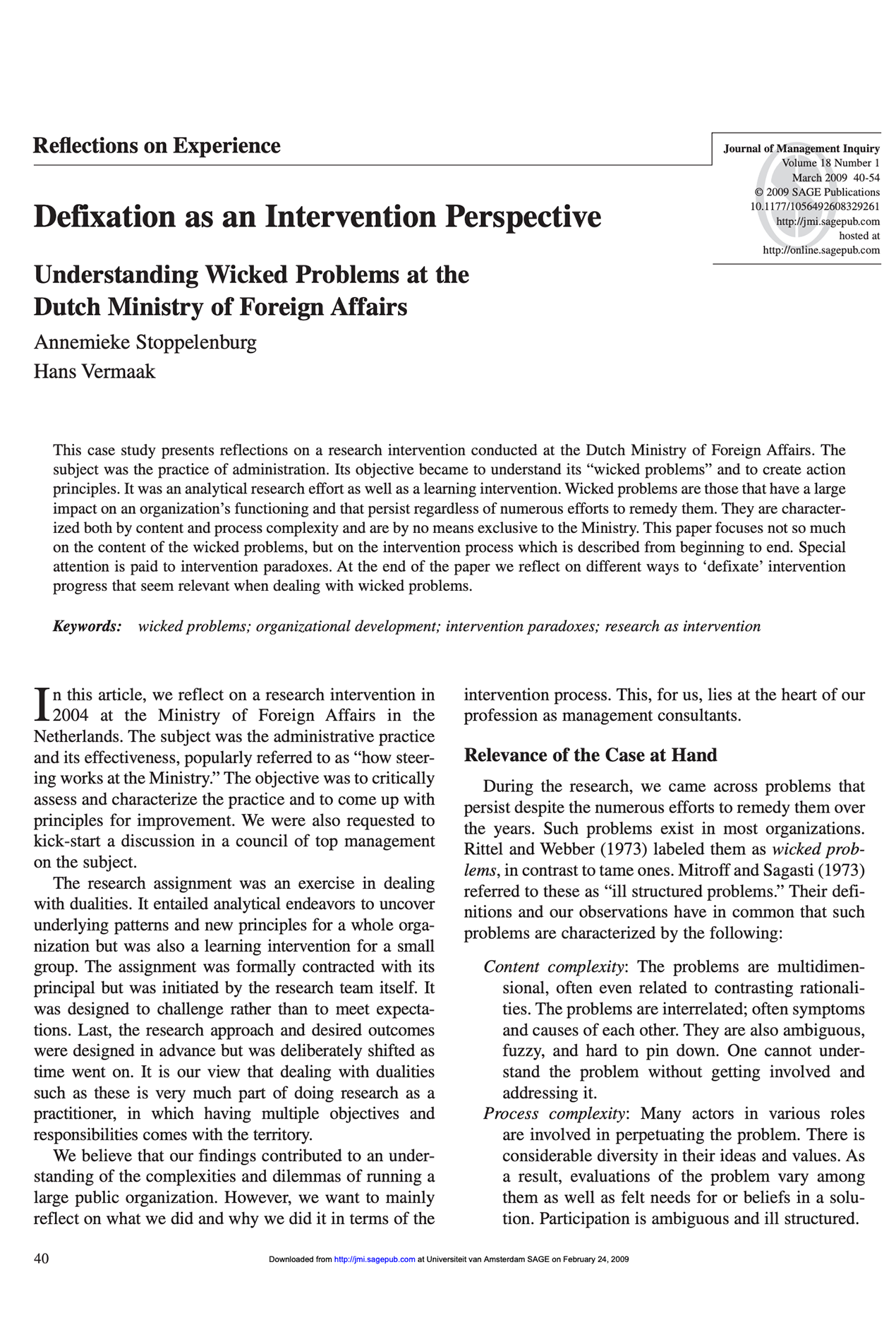
Understanding Wicked Problems at the Dutch Ministry of Foreign Affairs.
A. Stoppelenburg, H. Vermaak - Journal of Management Inquiry, 2009
Systemic research to uncover the unwritten rules of an organization
This case study presents reflections on a research intervention conducted at the Dutch Ministry of Foreign Affairs. The subject was the practice of administration. Its objective became to understand its “wicked problems” and to create action principles. It was an analytical research effort as well as a learning intervention. Read more…
Stretching the Practice of this Dialogic Approach
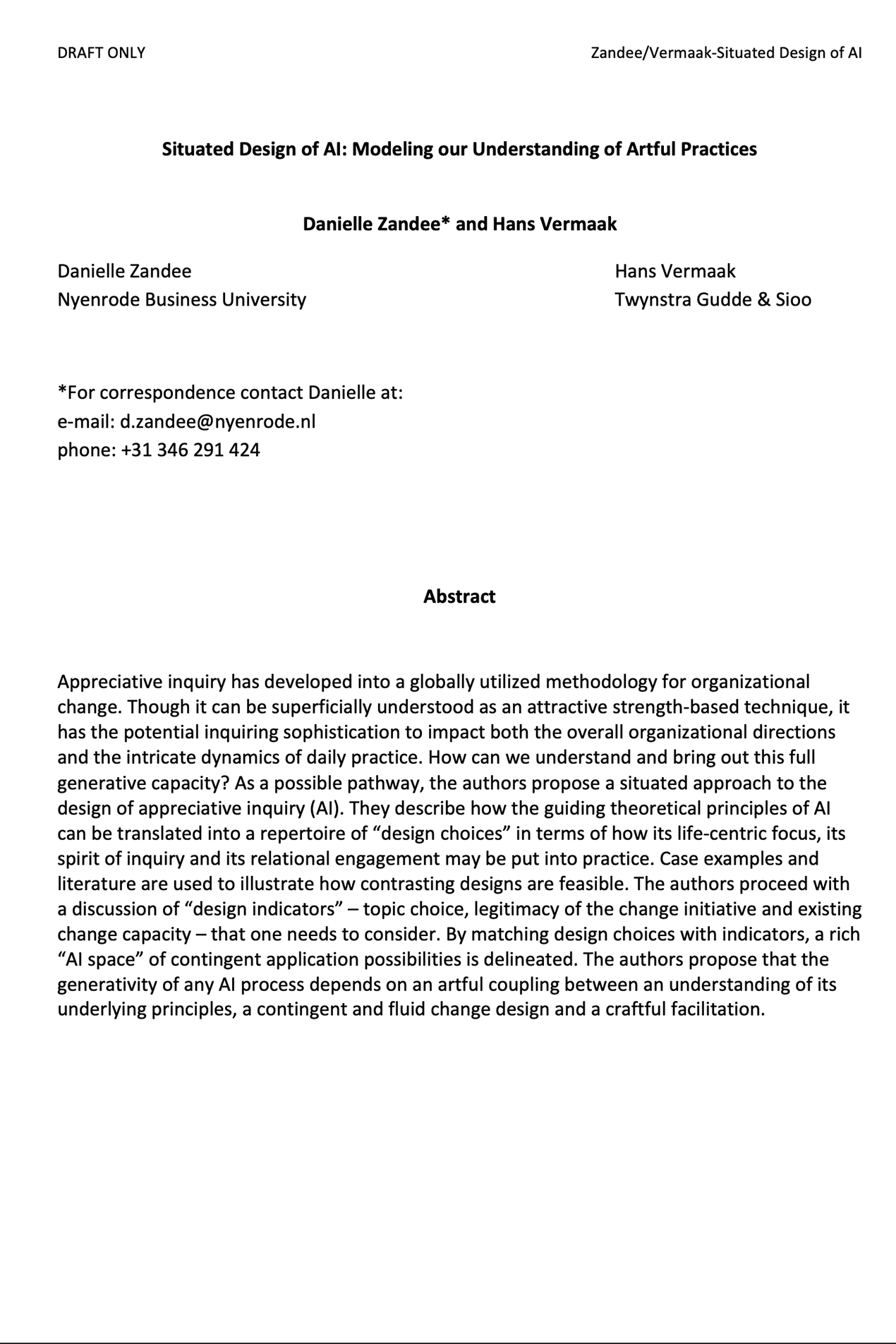
Danielle Zandee and Hans Vermaak – Paper Organizational Discourse Conference, 2012
A common language for situated AI design based on a discussion of current contrasting practices and recurring criticism of prevailing AI designs. How can we get more out of this intervention approach?
Because of its apparent simplicity and luring strength-based stance, appreciative inquiry can be misunderstood as an attractive and easy to emulate technique. Such misunderstanding may cause slippage from thoughtful inquiry into a managerial tool to create motivational experiences at work rather than to engage with complex issues. Such slippage may ultimately turn the appreciative approach into another disappointing management fad. Fortunately, the prolific use of appreciative inquiry during the last decades provides us with rich experiential material for timely reflection, critique and renewal.
Read more…
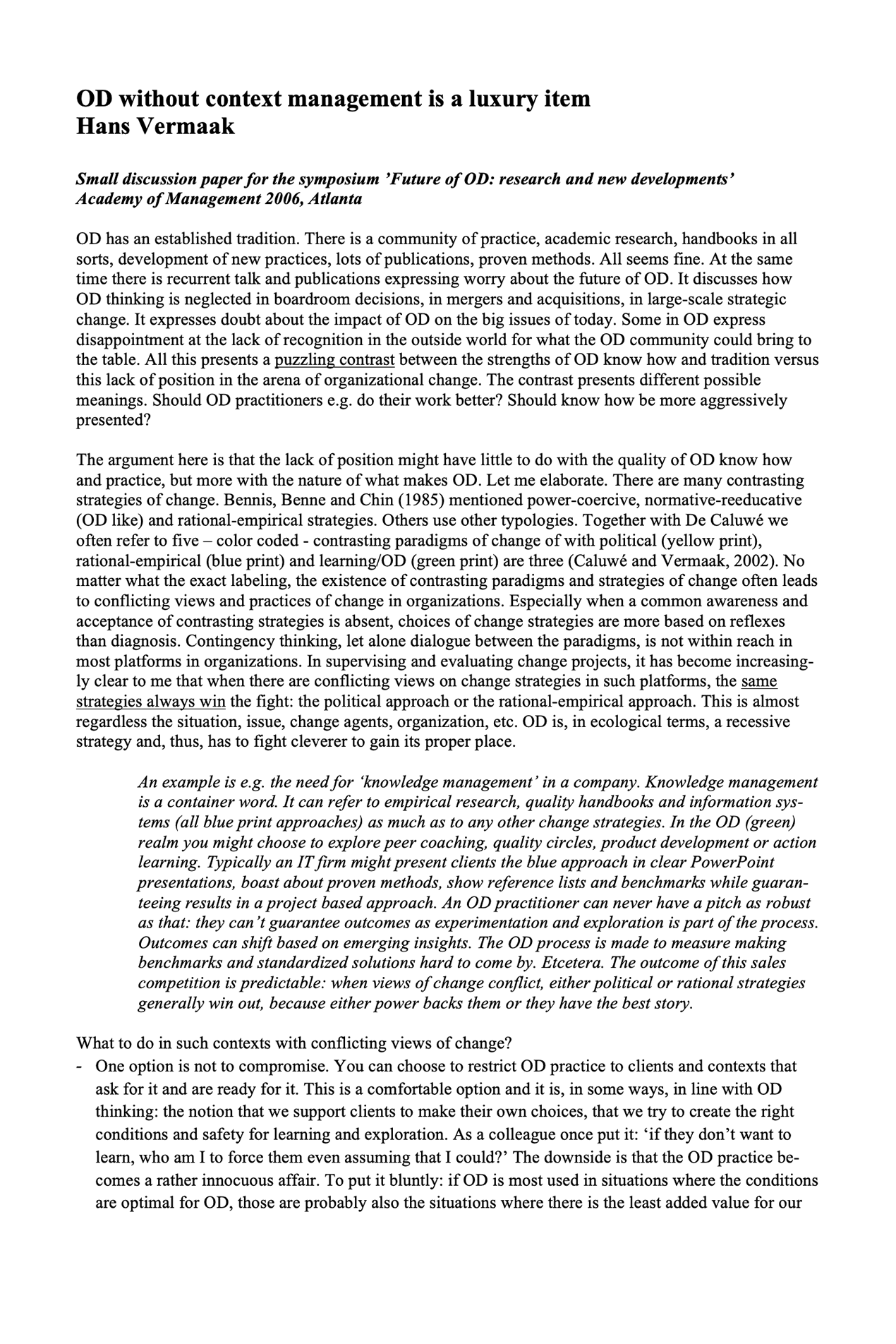
Paper for a symposium on the future of Organizational Development
Hans Vermaak, Annual Academy of management Conference, 2006
Organization Development suffers from a lack of pragmatism about power
OD has an established tradition. There is a community of practice, academic research, handbooks in all sorts, development of new practices, lots of publications, proven methods. All seems fine. At the same time there is recurrent talk and publications expressing worry about the future of OD. Read more…
In: J. Boonstra, L. de Caluwé (eds.) Intervening and changing - Wiley, 2007
Hans Vermaak
Intervention choices and paradoxes in practical application.
Causal loop diagrams can help in tackling complex issues effectively. Until the nineteen-seventies the literature focussed on the technique of such diagrams. Since then it has become evident that participation of stakeholders in making and applying such diagrams is desired to affect change. Read more…
Hans Vermaak, Mathieu Weggeman - Management Decision, 1999
Evergreen lessons for dealing with professionals … and enjoying it.
Professionalism still is on the way up. However, the working methods of managers and professionals do not develop at the same pace. Professionals often seek out their workplace within an organisation but then proceed to act as soloists, which makes fragmentation, mediocrity and non-commitment the rule rather than the exception. The manager’s reflex dictates that he/she tackles problems with control and command, resulting in all sorts of conflicts. Read more…
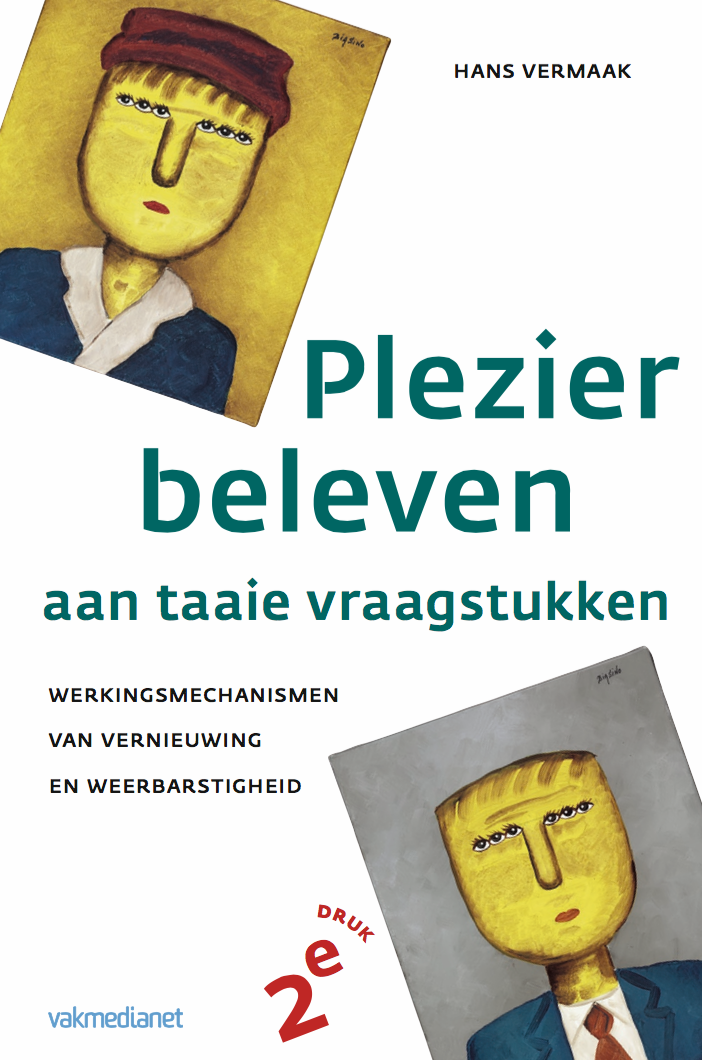
Dynamics of innovation and stagnation
Hans Vermaak, Kluwer 2009
How to deal effectively with complex change? Based on years of research the Dutch book won many awards. To give English readers a ‘taste’, the original summary is made available here.
There is no shortage of tough issues: whether it is collaboration between professionals, external oriented government, sustainable economy or development cooperation. They are characterized by complexity of different kinds: many factors and many actors are involved. It makes tough issues hard to pin down and impossible to eradicate. The dominant change repertoires are ill equipped for tough issues: clear division of tasks and responsibilities, minimizing conflicts, drawing up organizational missions, rolling out large-scale change programs Read more…
In: D. W. Jamieson, Barnett & A Buono (eds.) Consultation for Organizational Change Revisited - Information Age Publishing, 2016
Hans Vermaak
Mastering an instrument for systemic and interactive change
A persistent stereotype of consultants is that of experts who have all the answers. However, the more complex problems are, the less consultants are able to provide ‘magical solutions’. Causal loop diagrams (CLDs) are a powerful tool to deal with issues characterized by content complexity and process complexity. Read more…